
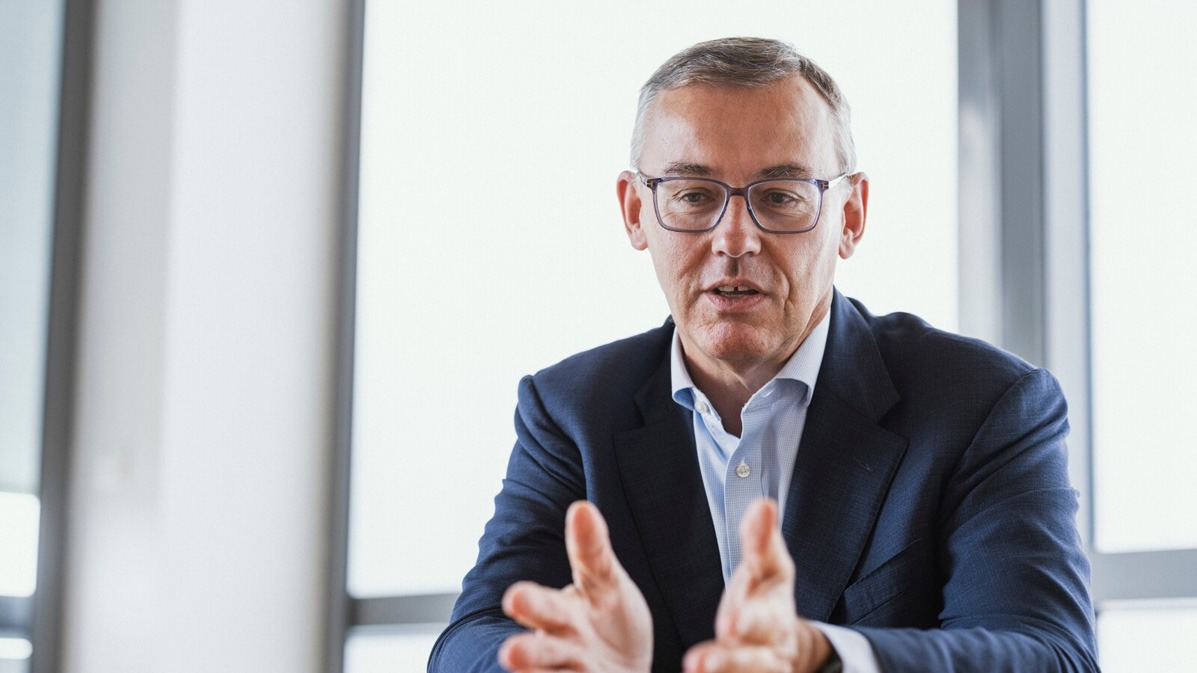
Peugeot’s top executive calls for innovation among European brands so they can remain alive 20 years from now in the face of growing pressure from Chinese manufacturers.
By Xavier Pérez (Prensa Ibérica / Spain)
Alain Favey is a guerrilla fighter of the automotive world. He has spent more than 30 years in the industry and now, as Peugeot’s CEO, he takes on the challenge of leading the brand after having to offer a mea culpa over the entire PureTech engine affair. El Periódico and Neomotor (Prensa Ibérica) had the opportunity to speak with him during the last Beijing Motor Show, where the French lion brand unveiled two prototypes designed to mark a major comeback in a market where it had already been present with the PSA Group (Peugeot and Citroën) since 1992, before withdrawing in 2019.
Born in February 1967 in L’Isle-Adam, north of Paris, Alain Favey comes from a middle‑class family where cars were part of everyday life. His father began his career at the brand’s Poissy plant as a factory worker before becoming an executive at Ford. In 1991, Favey joined Citroën as pricing manager and became one of the group’s youngest subsidiary directors when he was appointed to lead the Danish division in 1997. He later moved to the Volkswagen Group, where he headed brands such as Škoda and Bentley, among others. Until Peugeot came knocking in 2025.
You face an important challenge: cleaning up the image of the PureTech issue, and you were the first to acknowledge the mistake. Was it easy?
No, the truth is that it was very difficult to convince the company to do it, but it was absolutely necessary. For me, it has been a source of great frustration. Every day you wake up and all you see on the internet is “PureTech, PureTech, PureTech.” And the reality is that for the past four years the engines have been fine, and now we have a completely new engine that has no issues at all.
So…
Exactly — why are we still carrying this PureTech image? We need that message to be amplified. I understand that there are still customers driving those older engines, who have problems and are angry. I get it. But we also need to clearly say that the current engines do not have that issue. Because someone looking for a new car today might think Peugeot still has a problem, when that’s not the case. It’s very frustrating for us. We need to explain that it’s not the same thing. The image is not the same. The product is not the same.
You seem very convinced that the issue is solved. Is that so?
Yes. Peugeot is not a risky business because we trust that a defect will not appear twice. I don’t know exactly what went wrong in the whole process, but what I can say is that all the solutions, guarantees, tests, special coverages and investigations related to this issue have been incorporated into the development of the new engine, ensuring that problems of this kind will not reappear. I care deeply about protecting our reputation — it’s essential in this business.
Was it essential to acknowledge the mistake?
Of course. When the engineers who developed PureTech explain what went wrong, what they learned and how they are using that experience to avoid it with the new engine, they are much more credible. Because people say: “How could you think of putting that in the oil?” But when the people who did it explain what they learned, it creates credibility and also shows that it’s a very human process.
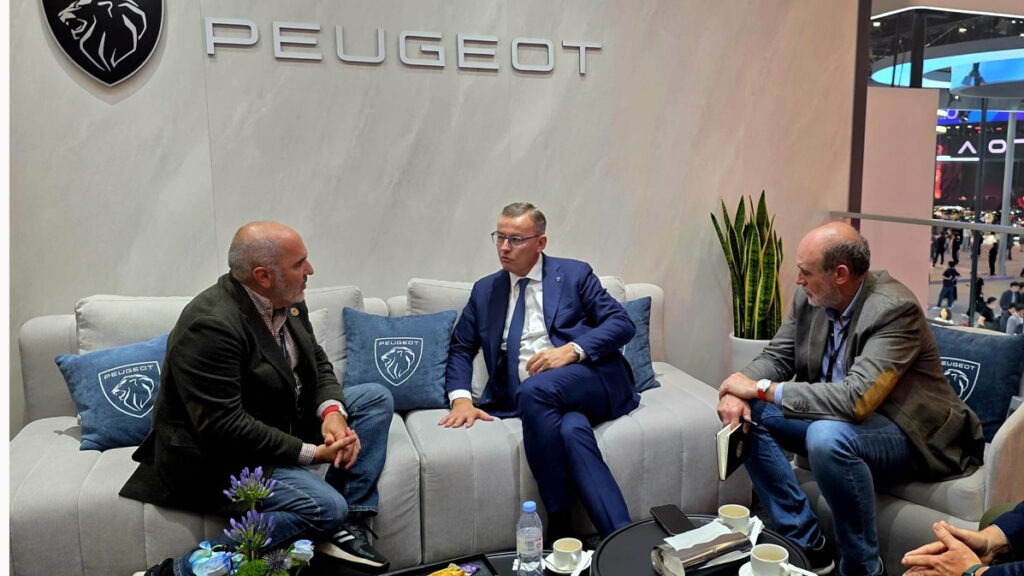
Speaking of the prototypes shown at the Beijing Motor Show — do you think these cars would work in Europe?
No. In Europe we believe our cars are already very good. The new 208 we will launch next year will be spectacular, with a different but very strong design for the B‑segment. The “Polygon” concept was not made for China; we made it for Europe. We wanted to show what a small Peugeot could look like: very modern, very striking. The 5.20‑meter SUV we have here will never be sold in Europe. It’s not a design issue, it’s a physical one: it’s simply too big and there would be no market for it.
Do you think Europe has stalled in recent decades while the rest of the world has moved very fast?
I understand what you mean, but we are trying to drive change in Europe. From the beginning, Peugeot has been very committed to electrification. That’s why we offer multi‑energy solutions. Today I look at April orders: Spain, 5% electric; Italy, 1%; France, 53%; Germany, 42%. So it’s very clear that Europe is not homogeneous. Each country has a different approach based on subsidies, policies and culture. In Beijing, 65% of the market is electric. If you don’t have EVs here, you can’t compete.
But Spain is moving very slowly. What’s the solution?
Our answer today is multi‑energy: offering electric and non‑electric options in every segment. The main issue is not price — it’s affordability. Electric cars must be affordable, and to achieve that they need support. In Italy last year, with subsidies, Leapmotor sold 12,000 cars in one hour. When a car costs 6,000 euros, people buy it. France and Germany subsidize heavily, and that’s why adoption is higher. Spain also subsidizes through the Auto Plan, but not enough to trigger a massive shift. When cars become more affordable and governments provide more support, demand will rise. It will happen in Spain, but it will take time.
You are preparing the launch of the Peugeot 208 GTi while already announcing the new electric Peugeot 208 for next year. Aren’t they too close in time?
You’re right. The 208 GTi should have been launched earlier. When I arrived, I decided to launch it because I knew people wanted it, but ideally it should have been done two years sooner. The new 208 will not be available as a GTi in its first years, so anyone who wants a GTi now will have a great option. The new 208 will arrive in September–October next year. Its design marks the beginning of a new language: horizontal lights instead of vertical ones. Many say Peugeot must be vertical, but sometimes designers are ahead of the public. We believe this language is more modern and will be the basis for our future models.
You are also presenting a new steering wheel, the HyperSquare. Is such a radical change necessary?
Yes. We need to innovate. Because if we don’t, I’m not sure there will still be a European automotive industry in 20 years. We want to create innovation that brings people pleasure. The HyperSquare is a completely new and modern expression. Young customers will understand it immediately. Older ones, like me, will need 10 or 15 minutes, but then they’ll realize it’s the future. In 20 years, all cars will have this type of control. And Peugeot will be one of the pioneers bringing it to the mass market.
Will we see this technology in other Stellantis brands?
Probably yes. If we have the technology, we will share it. Peugeot will be the pioneer, and the other brands will adopt it.
Why was the arrival of the large battery for the 308, 3008 and 5008 delayed so much?
It was a strategic decision, to avoid long‑term dependence on China. We decided to build a battery factory in northern France together with Total Energies and Mercedes. Three years ago it was a field; today it’s a factory. But we discovered that manufacturing batteries is extremely complex. There was no prior knowledge, no training. We had to learn what China and Korea learned 20 years ago. I’m proud of the progress, but commercially it caused delays and frustration. We acknowledge that mistake. We were too slow.
How important is Peugeot’s heritage compared to the new Chinese brands?
It’s fundamental. We have 216 years of history and have been building cars since 1889. We’ve gone through Japanese, Korean, Chinese competitors… and we’re still here. Because we keep innovating. The i‑Cockpit, multi‑energy, the HyperSquare. That gives us credibility to say we’re here to stay.
Many brands are betting on range‑extended EVs (REEVs). Is that an option for Peugeot?
Not for Europe. We will continue with mild‑hybrid and plug‑in hybrid. We have very powerful plug‑in hybrids: 225 hp in the 308 and 3008, 240 hp in the 408. We believe this is the right solution for Europe.
Why did Europe leave the entire hybrid field to brands like Toyota for so many years?
Because we bet very heavily on diesel for a long time. Until Dieselgate happened. Then everything had to change.